Posts By :

Efi Pylarinou

No Trade-offs: Give customers everything they want as cheaply as possible

No Trade-offs: Give customers everything they want as cheaply as possible

No Trade-offs: Give customers everything they want as cheaply as possible 800 420 Efi Pylarinou

No Trade-offs: Give customers everything they want as cheaply as possible

XY planning Network XYPN deployed successfully a subscription based offer for financial advisors in the US, 5years ago. They actually celebrated their 5yr birthday on April 4th with 900 members that use the service. This is evidence that a subscription service for financial advice works at the B2B2C level.

On the 28th of March, Charles Schwab took the subscription service of financial advice to another scale.

Charles Schwab subscription service rhymes with Apple`s news service.

For $30 a month, Schwab offers a financial planning package.

Schwab Intelligent Portfolios Premium (rebranded name) is offered at $30 a month after a one-time $300 fee with a $25k minimum. Asset allocation is from a universe of 50+ ETFs, including a financial plan with a customized roadmap and unlimited one-to-one guidance from a CFP professional. Regulated financial-investment advice at $630 a year. 

Schwab Intelligent Advisory (the original robo name) was at 28bps per annum 0.28% of assets.

Think of the 300,000 Schwab Intelligent Advisory accounts ($37 billion). Some will remain in the free, no-advisory offering. But a significant part will switch over to Schwab Intelligent Portfolios Premium and get advice.

Evidently, any account with enough assets ($125k seems to be the magic number) will switch over.

What will this move do to the rest of the large players?

When will Vanguard follow suit?

This is another discount brokerage moment in the investment industry. This is the subscription financial advice retail moment.

Eric Balchunas, the Bloomberg Intelligence analyst, has baptized the fee war that has been going on in the US, “the Vanguard Effect” simply because the major ETF producers rush to cut their fees, responding systematically to the lead of the 43yr old low-cost producer.

Now the Vanguard Effect` for financial advice is upon us but led by Schwab.

Be first in line for my best content

[1] “You’re able to get extraordinary quality at extraordinary value now,” Bettinger says. “That’s where our industry is. And in reality, that’s where the whole economy’s going.”
Bettinger is president of the Charles Schwab corporation
Source:https://www.bloomberg.com/news/features/2018-10-02/charles-schwab-on-his-3-6-trillion-edge-on-the-fintechs

I have no positions or commercial relationships with the companies or people mentioned. I am not receiving compensation for this post. 

Data Centers, AI and finance

Data Centers, AI and finance

Data Centers, AI and finance 800 533 Efi Pylarinou

Data Centers, AI and finance

Future data centers of all kinds will be built like high performance computers,” — Nvidia CEO Jensen Huang 

We are living in a world in which, more or less unconsciously, we increasingly “Trust in Math”. After the GPU adoption in business, we moved to new hardware that is not only faster but also smaller in size. We basically reinvented how data rooms looked.  

And this the world from Nvidia’s angle. They have facilitated the growth and new value creation, all powered by Artificial intelligence tools.  The use cases in Finance are immense. Fintech solutions for:

  • Operations: automating claims processing and underwriting in insurance
  • Customer service & engagement: alerting customer for fraud, chatbots, recommendations
  • Investing/Trading: automating research, trading signals, trading recommendations
  • Risk & Security: fraud detection, credit scoring, authentication, surveillance
  • Regulatory & Compliance: AML, KYC, automating compliance monitoring and auditing.

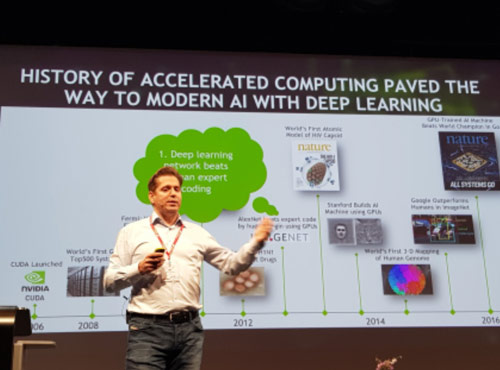
Marc Stampfli, the Swiss country manager at Nvidia shared the journey of the Artificial Intelligence Fall, Winter and into Spring, during his talk at the Fintech+ conference last year in Zurich. He explained neural network concepts borrowed from biology and the initial difficulties of neural network computations outperforming statistical approaches. The first tipping point came with increased data availability through the internet, and only then we had evidence that neural networks could outperform statistical models.

Data Centers, AI and finance

After that point, we ran into the next problem which was the lack of computing power to process all this data and multi-layer neural networks. And this is where GPU – a kind of parallel computer – was created and first used in vector mathematics. This is the technology of Nvidia’s processor.

The next inflection point came with the use of GPU to accelerate the next generation of machine learning algorithms. This led to an explosion of AI research, development and application, all powered by NVIDIA.

Today, NVIDIA is turning into a data center company. This positioning has become evident with NVIDIA’s announcement to buy the data center networking company Mellanox for $6.9B. This is the first large size acquisition for NVIDIA and one that is in alignment with their belief that Datacenter will play an ever-increasing changing strategic role whose architecture will need to be agile and scalable.

“Future financial service centers will be powered like high performance computers”.

2020 is only a year away. In March NVIDIA`s GPU Technology Conference (GTC) is the place to hear use cases and innovative approaches to AI from some of the world’s largest financial institutions at GTC.

Banks should steal the 2002 Bezos internal memo

Banks should steal the 2002 Bezos internal memo

Banks should steal the 2002 Bezos internal memo 800 533 Efi Pylarinou


Banks should steal the 2002 Bezos internal memo

Dear Banks,

It only takes an internal memo to ignite your own Bezos moment.

Five clear and crystal commandments[1] (“good artists borrow, great artists steal”)

that you can steal from Jeff B.:

1

All teams will henceforth expose their data and functionality through service interfaces.

2

Teams must communicate with each other through these interfaces

3

There will be no other form of inter-process communication allowed: no direct linking, no direct reads of another team’s data store, no shared-memory model, no back-doors whatsoever. The only communication allowed is via service interface calls over the network.

4

It doesn’t matter what technology they use. –(tech neutral)

5

All service interfaces, without exception, must be designed from the ground up to be externalizable. That is to say, the team must plan and design to be able to expose the interface to developers in the outside world. No except

Bezos ended his 2002 now famous mandate with a chilling little twist:

“Anyone who doesn’t do this will be fired. Thank you; have a nice day!”

Just 17 years later, you can feel free – I would say you should feel inclined to do so – and steal this. You can end your internal memo with a kinder twist:

“Anyone who doesn’t do this will no longer be with the team. Thank you; have a nice day!”

2019 in Finsev

I am using `Banking` to refer to financial institutions that have traditionally been in the business of serving retail, institutional, and corporate clients across all the spectrum of their needs. The Banking business model has been a PUSH operating model and the opaqueness and regulatory barriers to entry have allowed them to morph into a predominantly product business.

I celebrated this past March, 4yrs with Daily Fintech., during which I have been writing every single week on global innovations in Capital markets, wealth and Asset management[2].

I can safely say by now, that the only sustainable banking model is a PULL operating model that at its core becomes a platform as a service business. Much like Bezos transformed Amazon from a digital bookseller business, into a platform as a service.

For this to happen, the core transformation needed is in the `middle office` (conventional parlance) via APIs. Unless banks realize this, they will become suicidal and victims of a `lemming effect`. Their herd behavior to keep up with digitizing the `front office` to improve their customers` experience and even their engagement; will prove futile. The reason being, that as long as the culture remains that of selling products eventually; banks will find themselves in a commoditized business with margin going to zero.

“Any bank that does not transform its `middle office` via APIs; will become extinct. Thank you; have a nice day!”

The good news about this transformation is that it has lots of possibilities and variations. But a bank has to start its platformification process, first internally.

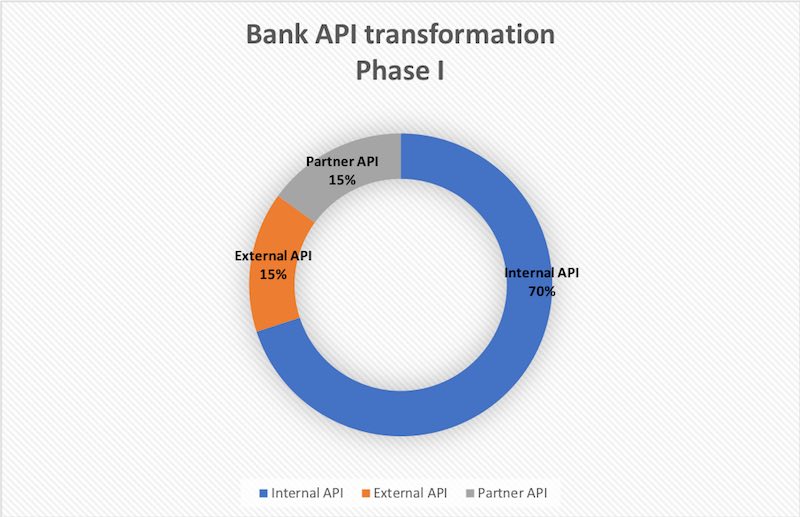
Think first Private APIs that enable each and every department to access data and workflows in real time. Then, one can think of Public APIsPartner APIs, and the Οpen Banking obligation or opportunity. Banking transformation needs to look more like 2/3 internal APIs in the first phase.

Bank API Bezos Article

Chris Skinner and Jim Marous, have been preaching relentlessly about these issues. But it seems that it is difficult to convince `Doubting Thomas`[3]. There is no reliable data (to my knowledge) on this topic that is essential, despite the fact that it may seem a `detail`. The devil always hides in the details.

Over the past 3yrs, I have been monitoring the Financial APIs from the Programmable Web and there is clearly an increase. From 2016 to date, we have gone from 1700+ to 3800+ financial APIs. Of course, there is no quality differentiation or usage stats with this doubling. And none of these stats, are related to the paramount internal transformation measured by Private or Internal APIs, and their usage.

Caravaggio incredulity of saint thomas.

The one piece of evidence that I can share with you, is from Goldman Sachs. Marquee [4], is the GS sophisticated freemium platform for its institutional clients, which I have used as a great example of `Empowering Asset Owners and the Buy Side` WealthTech Book, 2018 Wiley.

Adam Korn, who has spearheaded the project of giving out Marquee for free, reported late last year that:

` After months of work, Marquee now fields more than 100 million API calls each month, about 5 million of which come from outside Goldman’s four walls. Marquee now has roughly 12,000 monthly active users, split evenly between internal and external clients. And the number of users is beginning to increase, according to Korn.`

Efi Pylarinou Quotations Pointer

It only takes an internal memo to ignite your own Bezos moment.

[1] The API Manifesto Success Story

https://www.profocustechnology.com/enterprise/api-manifesto-success-story/

[2] https://dailyfintech.com/author/efipylarinou/

[3] A doubting Thomas is a skeptic who refuses to believe without direct personal experience—a reference to the Apostle Thomas, who refused to believe that the resurrected Jesus had appeared to the ten other apostles, until he could see and feel the wounds received by Jesus on the cross. https://en.wikipedia.org/wiki/Doubting_Thomas

[4] Named in honor of CIO R. Martin Chavez, known by everyone as “Marty”.

 I have no positions or commercial relationships with the companies or people mentioned. I am not receiving compensation for this post.

The first investment bank to tokenize its own real-estate holdings - ReitBZ

The first investment bank to tokenize its own real-estate holdings – ReitBZ

The first investment bank to tokenize its own real-estate holdings – ReitBZ 800 590 Efi Pylarinou


The first investment bank to tokenize its own real-estate holdings – ReitBZ

Banco Pactual (BTG) from Brazil is the first `Shark` that makes my Davos prediction true.  The next generation of structured products, asset-backed by illiquid real estate, is being designed as we speak in the labs of incumbent banks.

ReitBz Logo, Brazil

Reitbz is its name, and is I believe the first security token (STO) backed by a traditional investment bank. $10 for one ReitBz token. No US or Brazilian citizens.  You can pay with ETH or USD pegged coined Gemini Dollar.

I am excited because this comes from Brazil and not Manhattan or Canary Wharf real estate. Second, because ReitBZ is backed by distressed real estate that BTG Pactual has access to, as they have been a leading investor in Latam real estate for many years. They manage over $2billion and earned the Euromoney award for Best Real Estate investors in 2017 and 2018. Of course, in this phase they will tokenize only $15million worth from their holdings.

An Emerging Markets leader in real estate investing, issues, backs and manages the STO.

The real estate portfolio to be tokenized by BTG, has is a niche focus in three ways:

  • Real estate foreclosures by developers who were denied financing post-construction.
  • Real estate returned by buyers that couldn’t afford a bank loan after construction.
  • Real estate owned by companies that filed for bankruptcy or judicial recovery

ReitBZ is a transparent structure to invest in deal flow that is not accessible easily.

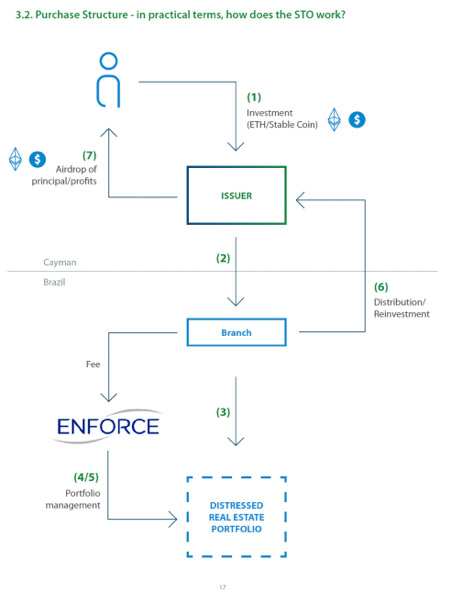
The funds raised will not be held by the BTG but by a smart contract on the Ethereum protocol[1]. The management of the investment process (purchase, management of the assets, sale) will be done through Enforce, and entity that is 10yrs old. Blockchain technology reduces the costs of a traditional real estate investment fund substantially (custody, bookkeeping, fund admin, structuring etc). The exact savings, I guess will be reported once the structure is live. What is unclear to me, is whether these savings are higher than the tax benefits that investors enjoy through traditional REIT structures (which undoubtedly have much higher costs in structuring).

As the devil is always in the details, keep in mind that on the one hand the funds are kept in the smart contract but on the other hand all decisions are made by BTG/Enforce. They are looking to buy assets at a 30% to 40% discount and over an 18month period, they aim to restructure them and sell them. They estimate that the restructuring process involves 10% to 20% costs. Once the property is sold at a profit, the managers will decide to distribute on a prorated basis the profits via dividends, which will take the form of Airdrops.

You can read the white paper and the one pager on their site ReitBZ.io.

The fee structure for Enforce is in the White paper (p.18)

  • 1% on the funds allocated to buy a given Target Asset
  • 10% on the net collection arising from the sale of Target Assets (i.e. sale value, reduced by all costs related to the real estate, fees and taxes)
  • 30% performance fee on the amount exceeding a 15%/year post-tax hurdle rate of the Target Assets portfolio

An oscillation between centralization and decentralization is normal. Market forces will determine the sweet spot.

Look at the ReitBZ to realize the structure`s positioning. As in the conventional world, you should always read the covenants. I take this opportunity to highlight the Petro structure which is collateralized by Venezuelan oil resources. The question arises as to how the structure protects the investor to actually be able to access the collateral. Same questions arise for the ReitBZ structure. Real Estate in Brazil, of course, valued and traded in Brazilian Real,….

Cost savings for the investor in complex structures that pool illiquid assets are not that obvious. Again, this is from experience from the financial engineering conventional world. All the setup costs may be lower for digital assets, but what about the fees of BTG/Pactual (seems to me borrowed from the old world much like the crypto hedge funds have done) and what about building in tax efficiencies? The truth is that we will need a few iterations of STO asset-backed structures to figure out how to optimize them.

[1] The legal structure is in the Cayman Islands.

Sources: LATIN AMERICA’S BIGGEST INVESTMENT BANK LAUNCHES SECURITY TOKEN, Bicoinst

Are robo-advisors about Low-cost products or `Passive beats Active`?

Are robo-advisors about Low-cost products or `Passive beats Active`?

Are robo-advisors about Low-cost products or `Passive beats Active`? 800 449 Efi Pylarinou


Are robo-advisors about Low-cost products or `Passive beats Active`?

We live in a world that is using new words in an accelerated pace. I recently ran across the hashtag #phygital. Which reminded me of the hybrid nature of robo-advisory services that has emerged from the growth of robo-services.

The various robo services that have been launched over the past ten years, have transformed the investment management space into a predominately low-cost product space.

Last year, Victor Hagahni and James White – Victor is the Founder and CIO of Elm Partners, and James is Elm’s CEO – wrote an article Is Vanguard More Rolls Royce, or Hyundai? that highlighted an investment world particularity:

With most products and services – cars, doctors, food etc – better quality normally goes hand-in-hand with a higher price. Not so with investing.

They even quote Bill McNabb, former CEO of the Vanguard Group saying:

The whole cost argument from an investment perspective is counter-intuitive.

Listening to Bill McNabb`s short interview at the 2019 Academic and Practitioner Symposium on Mutual Funds and ETFs, he makes a very important point that is not well understood.

The transformation in the investment management space is clearly turned the space into A low-cost product space.

This often is confused with a transformation into A passive beats active space.

The growth of robo-advisory (apologies for the umbrella term) is Not about passive over active. Robo-advisory is about the wide spread use of low cost products. We live in a world that it is becoming more difficult to imagine high cost investment products.

One of the best examples of low cost, active and passive management, is Elm Partners.

12bps, tax harvesting, portfolio construction based on economic fundamentals and other liquid risk premia in addition to equity market Beta.

Listen to Victor Hagahni and James White discuss their approach which is for accredited investors only. Their offering includes less than half a dozen investment programs and the possibility of SMAs.

Elm Partners does not aim to do everything for everybody. Low cost and transparency is paramount for their business. You can follow their quarterly reporting on Seeking Alpha, here. You can follow their thoughtful research here. You can savor Victor`s Tedx Talk Where are all the Billionaires? & Why should We Care?: where he uses the puzzle of the missing billionaires to help us explore how and why most investors fail to capture the returns offered by the market. This actually leads into the main reasoning for Elm Partners investment strategy, the so-called “Active Index Investing.”

Listen to Victor Hagahni and James White discuss with me their approach which is for accredited investors only. Their offering includes less than half a dozen investment programs and the possibility of SMAs. Elm Partners does not aim to do everything for everybody. Low cost and transparency are paramount for their business.


[1] Former Chairman and CEO of Vanguard, Bill McNabb Discusses the Future of the Investment Industry from the 2019 Academic and Practitioner Symposium on Mutual Funds and ETFs. Presented by UVA Darden and the Investment Company Institute.

https://www.youtube.com/watch?v=Z8UQvkKbFZo

Margin lending with no Counterparty risk– the Dharma open source protocol

Margin lending with no Counterparty risk – the Dharma open source protocol

Margin lending with no Counterparty risk – the Dharma open source protocol 800 533 Efi Pylarinou


Margin lending with no Counterparty risk – the Dharma open source protocol

In November 2017[1], I spoke to Nadav Hollander in California, the founder of Dharma.io, who had just “graduated” from Y-combinator. At the time, he described his vision to create on the blockchain a tokenized marketplace for loans. In February 2018, the Dharma open source protocol went into alpha testing.

Developers could easily use the Dharma libraries to:

  • Allow would-be borrowers and lender to generate open loan requests for debt agreements of any kind
  • Allow lenders to fill loan requests, formalizing a lending agreement with a borrower
  • Allow users to manage their lending portfolio by making repayments, collecting collateral, trading their debt tokens, etc.
  • Earn fees by underwriting debt agreements generated by Dharma protocol
  • Earn fees by relaying debt agreements between borrowers and lenders

Source Hello, Dharma.js

Dharma didn’t ICO because Hollander believed that token models were very immature right now. Hollander says “I’d rather build a community of constituent users and, only if and when it makes sense, issue a protocol token.” For now, Dharma open source protocol has no native token, but each loan that is created is a token itself

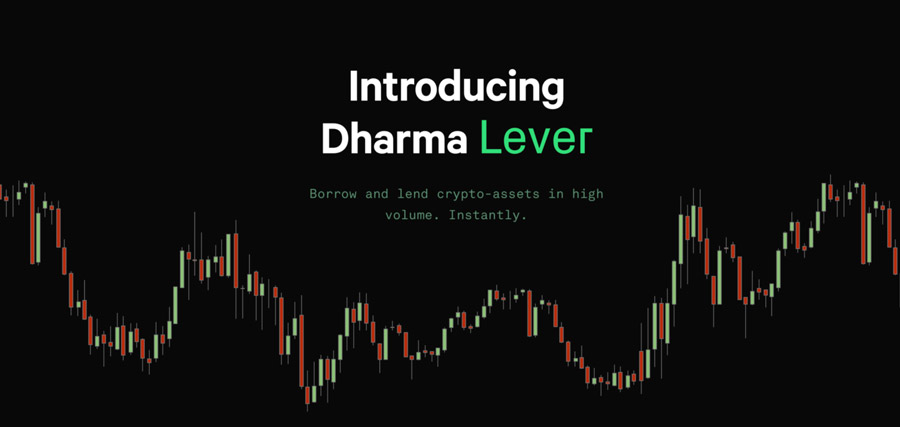
Fast forward to today, February 2019, one year later and Dharma raised $7 million from big investors including Coinbase Ventures who naturally are interested in crypto lending markets, especially for traders. Dharma has already launched the Dharma Lever product (in alpha mode) that deploys smart contract’s to offer margin loans for crypto traders from high volume investors.

No counterparty risk (smart contract risk, since assets are held there).
Instantly, at very low cost.
Lower borrowing rates than centralized exchanges.
Compatible with all wallets.

Margin lending with no Counterparty risk– the Dharma open source protocol

Dharma is in the same league as Maker – be your own bank or Defi[2] – that allow us to borrow against our Hodlings. Dharma involves no DAI and accommodates several cryptocurrencies beyond ETH. They are even looking to add WBTC soon which went live on Ethereum just last week.

WBTC – Wrapped Bitcoin is an ethereum-based token that is backed one-to-one by a regular bitcoin BTC.

It is already listed on several DEXs[3] including Radar Relay, Kyber Network, and AirSwap.

Dharma is changing the crypto lending space with their Lever offering that eliminates counterparty risk and replaces it with smart contract risk.

Margin lending with no Counterparty risk– the Dharma open source protocol

The Dharma Lever is one way to mitigate systemic crisis due to the domino effect of counterparty failures.

[1] I introduced Dharma in my Feb 2018 post Bonds & loans on the Blockchainalong with Tzero and Nivaura.

[2] Defi = Decentralized Finance, see more here.

[3] Read more about DEXs in `Are Decentralized Exchanges part oft he bottom up decentralized monetary policy?`

WhenBiance WhenSix

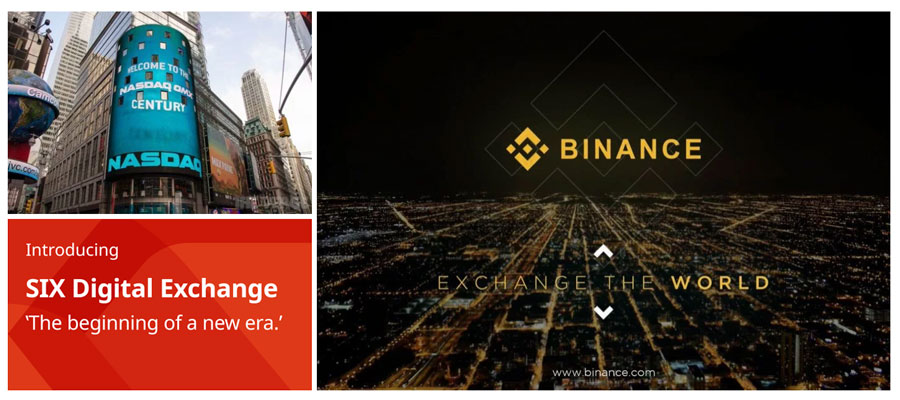
A world of #WhenBinance & #WhenSIX

A world of #WhenBinance & #WhenSIX 1200 800 Efi Pylarinou


A world of #WhenBinance & #WhenSIX

Stock Exchanges are the fastest and most efficient data-processing large scale system that we humans have designed so far [1].

Stock exchanges need roughly 15minutes of trade to determine the effect of a piece of news – political, scientific, ecological, societal etc – on the prices of shares.

WhenBiance WhenSix

DLT technology may change this but the How is up in the air.

In Stock exchanges and listed assets  – Part I I looked at Nasdaq`s use cases. In this second part, I am sharing insights on the pulse of the securities markets as they reshaped and get pulled (down or up) by DLT technology. As mentioned in the Foreword of the SIX white paper The Future of the Securities Value Chain, one of the reasons to look into this topic is to sharpen our understanding of what the relevant future may look like and to seek feedback and open a conversation.

With DLT technology there will be a boom in what is tokenized or securitized in traditional parlance. There is no disagreement on this front, just on the degree maybe and the when. However, the devil is in the details as always. How will this happen?

If we all agree that there will be more securities out there, what will happen to Primary markets, Secondary markets and the post-trading processes? The 64page SIX white paper, describes eight possible scenarios with enough details – as they know how these markets operate currently – and in their Summary two pager they pick the two most likely ones. Of course, opinions will vary on the likeliness and this is where it gets interesting.

The way I see the world right now, is that

we have moved from #WhenMoon #WhenLambo to a world of #WhenBinance.

Even at LyCI online webinar presented by Richard Olsen, CEO of Lykke, the question of #WhenBinance for LyCI, was asked. Day traders and speculators naturally want listed assets but through the accelerated evolution of digital assets over the past two years, we have actually realized that investors also continue to attribute value to the listing of an asset. #AndTheIrony is that this signaling effect comes from the conventional investment culture and Not from the P2P progressive culture that Satoshi Nakamoto made technologically possible.

#AndTheIrony is that for now, both retail and institutional investors in the digital assets world perceive listing as a measure of fundamental quality. Whether it is about cryptocurrencies, utility and payment tokens, asset-backed coins (commodities, real estate, revenue sharing), security tokens etc. listing makes them more valuable.

The way we are plowing ahead to increase adoption of digital assets, we are consciously or unconsciously, making sure that LISTED ASSETS WILL CONTINUE TO BE THE DOMINANT STRUCTURE IN SECURITIES MARKETS.

In such a world, we could see growth in issuing marketplaces for digital assets of all sorts, but continuously tied to the new digital exchanges. As we speak there are several issuing marketplaces launched for digital assets: Securitize, TokenSoft, Neufund, Desico, Mobu, …. And more than needed exchanges to list these assets. At the same time, incumbents like SIX and Nasdaq, are building infrastructure to prepare for a position in the digital assets boom. Most, if not all, of these initiatives, will deploy permissioned central ledgers that deviate from the Satoshi Nakamoto core principals.

Right now we are heading straight into a future for securities that is based on permissioned central ledgers and in which listed securities remain the only way to unlock full value and then some. We will have reduced costs, reduced intermediaries, a larger pie of digital assets but we will have not changed this:

Exchanges will remain the fastest and most efficient data-processing large scale system that we humans have designed.

A Satoshi Nakamoto fully aligned world, is one in which exchanges disappear simply because listing does not add value. In such a world, all issuing marketplaces are open and not permissioned. Issuing becomes ubiquitous. Imagine a world in which either on Amazon or Wechat, even retail can issue a security or a token, and investors can directly access these. This requires to move Fintech crowdfunding venues like Angelist and Crowdcube, and P2P lending venues like Prosper and Lending Club, onto protocols like HarborDharma, or Swarm. Then to get all large corporates (BMW, Johnson & Jonhson, ect) the software to issue and trade P2P within their ecosystems – i.e. DEX software. But before all this can happen, we need to solve the Digital Identity issue for both individuals and entities.

In a Satoshi Nakamoto fully aligned world, Exchanges become obsolete.

[1] The view of the Austrian school of economics

Money is a claim on an Institution and the reason for change

Money is a claim on an Institution and the reason for change

Money is a claim on an Institution and the reason for change 1000 655 Efi Pylarinou


Money is a claim on an Institution and the reason for change

Axess Think Tank, a Geneva based think tank organised a great event focused on four themes

  • The future of money
  • The Regulatory landscape
  • ICO-STO and Capital markets
  • Blockchain and the Token economy

I had the pleasure of moderating the last two panels.

One of the takeaways from the entire event, was around the issues of cryptocurrencies issued from Central Banks or some such.

When you have a board member of the SNB Andrea Maechler, a senior research advisor to the BOE Michael Kumhof, a research fellow of the Fed St. Louis & Professor at univ. of Basel Aleksander Berentsen, a research fellow of the UCL Center for Blockchain Technology Daniel Heller; there is a lot to absorb from their talks and panel discussions. Add to that the moderator Michel Girardin, from the Univ of Geneva and Jean-Pierre Roth, the ex Governor of SNB, in the audience.

They agreed that payments are the very heart of any economy and that we live in a world that customers expect payments to be like WhatsApp messages.

The SNB is actually following the innovations around payments, whether Fintech or Bitcoin originated. Andrea Maechler, emphasized that the SNB`s mandate is to support and promote cashless payments and this done through SIX. Fintechs that hold a FINMA payment license will be granted access to the SIX system.

Regarding CBDC`s they have concluded that it is not a tech issue but rather a policy issue. The SNB believes that while there are advantages, the main disadvantages, make CBDCs a no-no for the SNB. They see that a CBDC would increase the risk of bank run and would make monetary policy ineffective when it is actually mostly needed.

This is where Aleksander Bernesten actually stepped up and provoked the thinking. He firmly believes that Central Bank electronic money would increase financial stability. Give access directly to the CB to all.

His motto is that:

The Censorship resistant attribute of Bitcoin, is priceless!

He makes things simple by focusing on this attribute. Since there is no free lunch, we have to choose between

A Censorship resistant database which is inefficient and slow

Or

An efficient and fast centralized database which is not censorship resistant

He thinks that a central bank decentralized currency has no meaning at all. Forget about a Fedcoin type of idea. However, he proposes that Central banks issue electronic money for all! So instead of having the authorised commercial banks exclusively access directly the CB, we should all have direct access to the Central Bank. Forget about the RTGS system.

For those that want to understand more details read The Case for Central Bank Electronic Money and the Non-case for Central Bank Cryptocurrencies

Note: By joining Axess think tank you can access the video recordings of this high quality and more. Check it out here.

Don’t forget that currently

MONEY is a claim on the Central Bank or a commercial bank!
Will this change? How and when?
The Why has been answered: For a Censorship resistance monetary system.


[1] Central Bank Digital Currency

The AI powered tech rating agency with no conflicts of interest - Early Metrics

The tech rating agency with no conflicts of interest – Early Metrics

The tech rating agency with no conflicts of interest – Early Metrics 1100 636 Efi Pylarinou


The tech rating agency with no conflicts of interest – Early Metrics

Early matrix Logo

Early Metrics is an independent rating agency focused on early stage innovative tech startups. Operating out of Paris since 2014 and with significant presence in London, Berlin and TelAviv.

The tech startup world continues to grow as the cost to enter has dropped substantially and the capital looking to invest in the private markets is ample. Cost of failure for entrepreneurs is dropping too.

At the same time, the failure rate continues to hover around 90% which makes it challenging for investors. Corporate VC, VCs, private equity funds, family offices, angel investors are eager to pay for high quality deal flow that is conflict-free.

Undoubtedly, the subprime crisis brought to the forefront the long-standing conflict of interest in the oligopoly of rating agencies. The business model of all agencies has traditionally been that their “clients” are the companies that want to be rated.

Early Metrics is Not paid by the startups they rate.

Their business model puts the entities that are interested in partnering or investing in tech innovation, in the client position. Early Metrics clients can subscribe to one kind of service that offers a few select rated startups per month. A client can also request a detailed rating analysis for a tech growth company that they are focused on. The “to be rated” company can be a partnership candidate or a first investment prospect or under consideration for the next round of investing. In other words, Early Metrics offers a conflict-free high quality deal flow service to subscribers. Focus is always on the growth potential of the tech innovation. It is a clear equity approach that offers certain KPIs and a proprietary qualitative component that covers elements that are traditionally gaged by instinct. We all know that VCs for example, access the founders, the team with a “gut + experience=instinct” kind of approach that they typically, brag about as “the” differentiation factor.

Early Metrics’ “secret sauce” has developed a process that accesses each team member, their management skills and actions, and most importantly, the value and risks of the team as a whole organism. This process entails training and certifying Early Metrics “analysts” that can interview the tech team and feed the data into the proprietary algorithm that is can provide signal on many fronts. In addition, the project and the technology is accessed and the ecosystem it is operating in. Therefore, the rating is a combination of an IT filter, data automation that allows a continuous rating (instead of a one-time snapshot), and the interview with the certified analysts.

Artificial Intelligence
Early Metrics is a great example of technology that addresses a significant agency problem in the corporate rating market.

It also fills in an under-served part of the rating market, as it is

focused on the equity aspect of innovative tech SMEs and early stage ventures, instead of the credit part that most conventional rating agency address.

In practice currently, Early Metrics “plays” in the tech growth part of the market, with companies that have up to $20mil annual turnover. Naturally, startups are applying to be rated but Early Metrics ranks the “to be rated” pipeline as a function of the interests and focus of its clients. In simple words, their needs to be a match between the Early Metrics clients and the SME or startup, to move up the “to be rated” pipeline.

Early Metrics has already an established client base of corporates that has extremely low turnover. The art of growing their business successfully lies in sourcing high quality deal flow and matching it with their client base. Their “human” rating secrete sauce is explained in detail in their webinar “How human factors affect the growth of early stage ventures” (free to watch here).

There are other companies that gather data and offer benchmarking reports in the startup space, but not with a laser focus. Oddup is the better-known name in the startup rating space but has a broad focus (not tech focus necessarily) and is strictly data driven. Mattermark was another player who was sold (liquidation kind of transaction) in December to Full Contact (details here).  StartupRanking focuses on social statistics (the SR web and the SR social).

In my opinion, the space has room for more service providers. Innovation in the rating methodology is needed and one way to develop the space is with a sector focus. An example is an impact startup rating service that can incorporate impact metrics. Impact metrics and innovation metrics are no low hanging fruit. Secret sauces can be developed for these.

“Early Metrics is growing and serves investors and blue-chip corporates such as Visa, LVMH, Barclays, Sanofi, and more.” They remain focused on bringing transparency to the rating process and serving the decision makers that fund innovation.

Stock exchanges and listed asset assets Part 1

Stock exchanges and listed assets – Part I

Stock exchanges and listed assets – Part I 1100 736 Efi Pylarinou


Stock exchanges and listed assets  – Part I 

At the time of its Series E fundraise in May 2018, shares of Circle were worth $16.23 a piece at a valuation of $3.01 billion, but in January 2019 shares are available to be purchased at just $3.80. To be sure, it is not clear how many shares are being offered at this new price, nor is it clear if any shares have exchanged on the platform at this price. This share price implies a $705M valuation.” excerpt from Prop Shares are Hard to Sell: Shares of Crypto exchange Circle are being offered at a massive discount.

The Austrian school of economics view is that

Stock Exchanges are the fastest and most efficient data-processing large scale system that we humans have designed so far.

Stock exchanges need roughly 15minutes of trade to determine the effect of a piece of news – political, scientific, ecological, societal etc – on the prices of shares.

Whether this will change with DLT technology and when, is up in the air. For now, we have old and powerful institutions running these data-processing systems and it wont be easy to steal their Cheese.
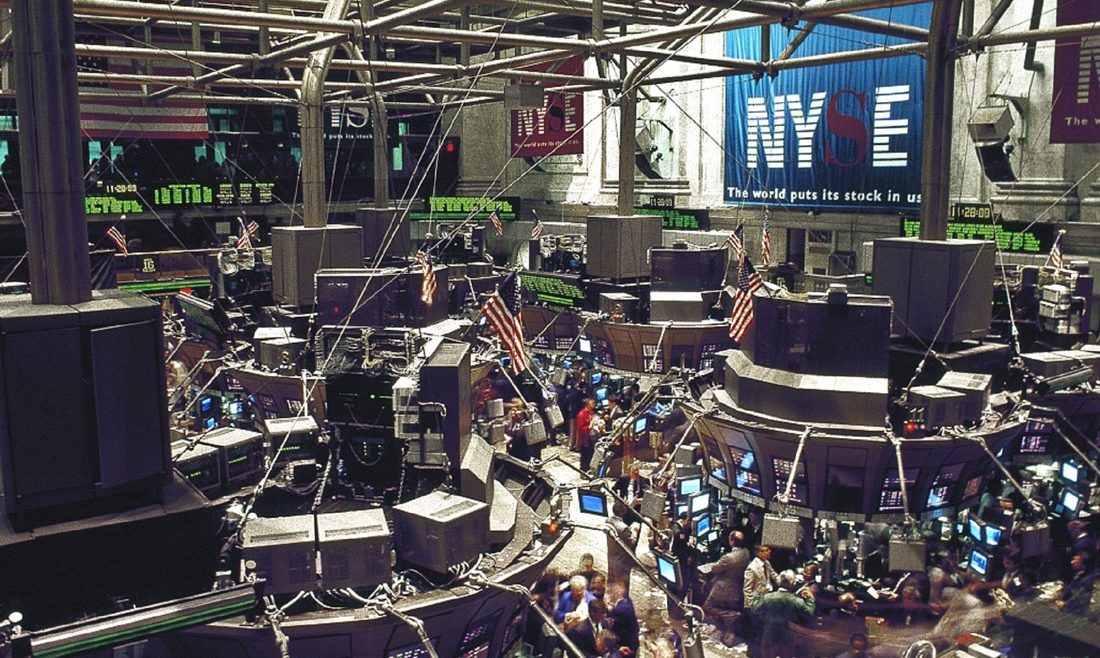
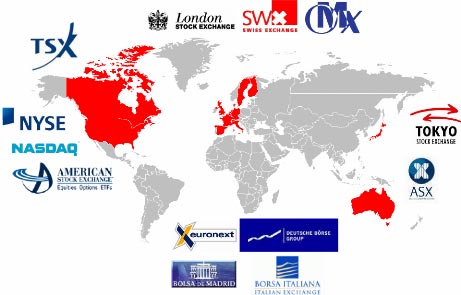
The Frankfurt Stock Exchange is over 400 yrs old with a market cap putting it in the 10th position globally. The London Stock Exchange (LSE) and the New York Stock Exchnage (NYSE) are bother over 200yrs old and are in the 3rd and 1st respectively by market cap. Just a few blocks away from the front runner, there is NASDAQ only 45yrs old and with a 2nd ranking in market cap.

The 29yr old Australian Securities Xchange (ASX) ranking 14th in size, is actually the bravest in that they were the first to explore DLT technology for their settlement and post trade activities. Digital Asset has been their partner, with whom they have been designing a replacement of their Clearing system CHESS since 2015, which they actually own (not the case for other stock exchanges). The full launch has been pushed out again from 2020 to 2021.
The architecture of this system maintains the messaging-based interaction with its participants and does not require them to have to run a node on the network in order to participate.

“We are often told by many, including other market infrastructures, ‘You’re so brave that you’re going first, you’re using DLT’ — we actually genuinely consider it brave to embark upon a large transformation program and not adopt this technology,” said Cliff Richards ASX`s executive general manager of Equity Post-Trade Services.

[1] Data source from the Visual Capitalist as of April 2017 – Comparing the largest Stock exchanges

Stock exchanges and listed asset assets Part 1

NASDAQ is the most active stock exchange by being involved in several different DLT initiatives that are however, recent.  In Spring 2016, in a post about Fintech in action on Western stock exchanges, I had mentioned Linq, a private blockchain company focused on private securities issuance. Linq allowed unlisted private companies to represent their share ownership digitally and securely. Later, Linq and Chain, a blockchain services provider, used DLT to register digitally ownership of private shares.

In May 2017, Nasdaq partnered with CitiConnect for Blockchain and took Linq to the next level. They went through a seamless end-to-end transactional process for private company securities.  Payment and reconciliation magic via DLT.

In October 2018, NASDAq also partnered with the Azure blockchain service of Microsoft. The aim is to integrate it in order to improve buyer-seller matching, management of delivery and payment. The key advantage they present is that this deployment will allow for interoperability with customers using various blockchains.

What really caught my attention is the Nasdaq`s use of DLT technology in their newswire services. They are starting to use smart contracts for time-sensitive data like corporate announcements, press releases, regulatory filings, etc and the associated valuable meta-data. Nasdaq seems to have filed for a patent around this  Nasdaq Gets Patent for Blockchain Newswire to Solve Gaps in Audit Trail Gaps and Errors!

For me this latest use case, can be big.

Distributing meta-data through smart contracts and giving access to it on a pay-as-you-go way, will be a huge business for stock exchanges

and Nasdaq can dominate in this.

Subscribe for our news updates and exclusive content.

Get all my best content in your inbox

Starting a project?

Contact Efi

Join my social circle

Social media

Fintech and Blockchain advisor

Switzerland
Tel: +41 78 944 3470

© 2024  Efi Pylarinou. Developed by Core Dynamix Digital Agency

    Privacy Preferences

    When you visit our website, it may store information through your browser from specific services, usually in the form of cookies. Here you can change your Privacy preferences. It is worth noting that blocking some types of cookies may impact your experience on our website and the services we are able to offer.


    Our website uses cookies, mainly from 3rd party services. Define your Privacy Preferences and/or agree to our use of cookies.